
Volleyball leagues are quietly everywhere in India: college championships, corporate tournaments on indoor courts, society leagues played under floodlights on sand or concrete. And more of them every season are choosing their teams the exciting way, through a live player auction instead of a captains' meeting.
An auction suits volleyball unusually well, because volleyball squads are small and every single pick matters. In a cricket auction a captain can hide one weak buy at number ten. On a volleyball court there is nowhere to hide anyone, and the rotation rule makes sure of it. This guide covers how to structure a volleyball auction: the categories, the purse maths for small squads and what your captains should really be bidding for.
Small squads change everything
Six players are on court at any time. A sensible league squad is eight to ten: six starters, two or three substitutes and a libero if your league uses one. That is it. Compare that with a cricket squad of fourteen or a football squad of eighteen and you see the first big difference: a volleyball auction is short, sharp and unforgiving.
With only eight to ten picks, a captain who wastes money on two players has damaged a fifth of the squad. There are no filler rounds where nobody is paying attention. Every lot is consequential, which makes for a tense, watchable auction, and it also means your purse and increment rules need more care than in bigger-squad sports. We will come to that.
The small squad also compresses the auction clock. Eight teams of nine players is only seventy-two lots. At a brisk pace that is a ninety-minute evening, which makes volleyball auctions perfect for a weeknight event at the club or office.
Categories: setters, attackers and liberos
Sort your registered players into categories that match how volleyball is actually played.
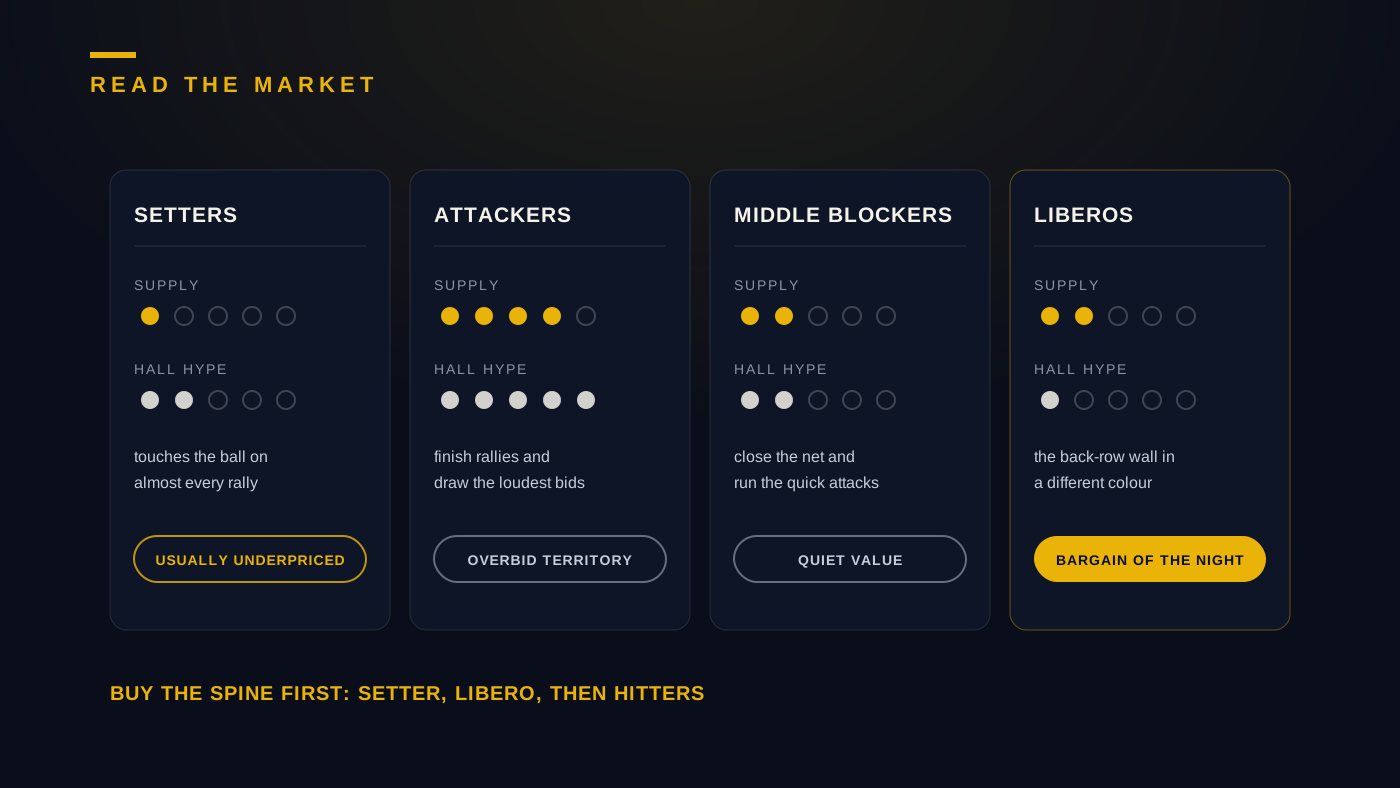
- Setters. The playmakers. A setter touches the ball on almost every rally and decides who attacks. A team with a good setter and average hitters will beat a team with great hitters and no setter, every time. There are never enough genuine setters in a local pool, so flag them clearly.
- Attackers. Your outside hitters and opposites, the players who finish rallies. If your pool is big enough, note who hits from the left, who hits from the right and who can swing from the back row.
- Middle blockers. Tall players who close the net and run quick attacks. In local leagues they often get lumped in with attackers, but a captain planning a defence wants to know who can actually block.
- Liberos and defensive specialists. The back-row wall. A libero cannot attack from above net height, wears a different colour and exists purely to receive serve and dig. Leagues that allow a libero should auction them as their own category, because captains value them completely differently from hitters.
Collect a self-declared category, height and preferred position at registration. If your auction software shows cricket-style fields, rename them: this is exactly what custom player fields exist for, and it is why organisers running non-cricket sports pick tools like AuctionXI, where the operator renames the stat columns to spikes, blocks and serve receive before importing the whole pool from Excel in one go.
What rotation does to player value
Here is the part first-time volleyball auction captains get wrong, and a good organiser briefs them on it before bidding starts.
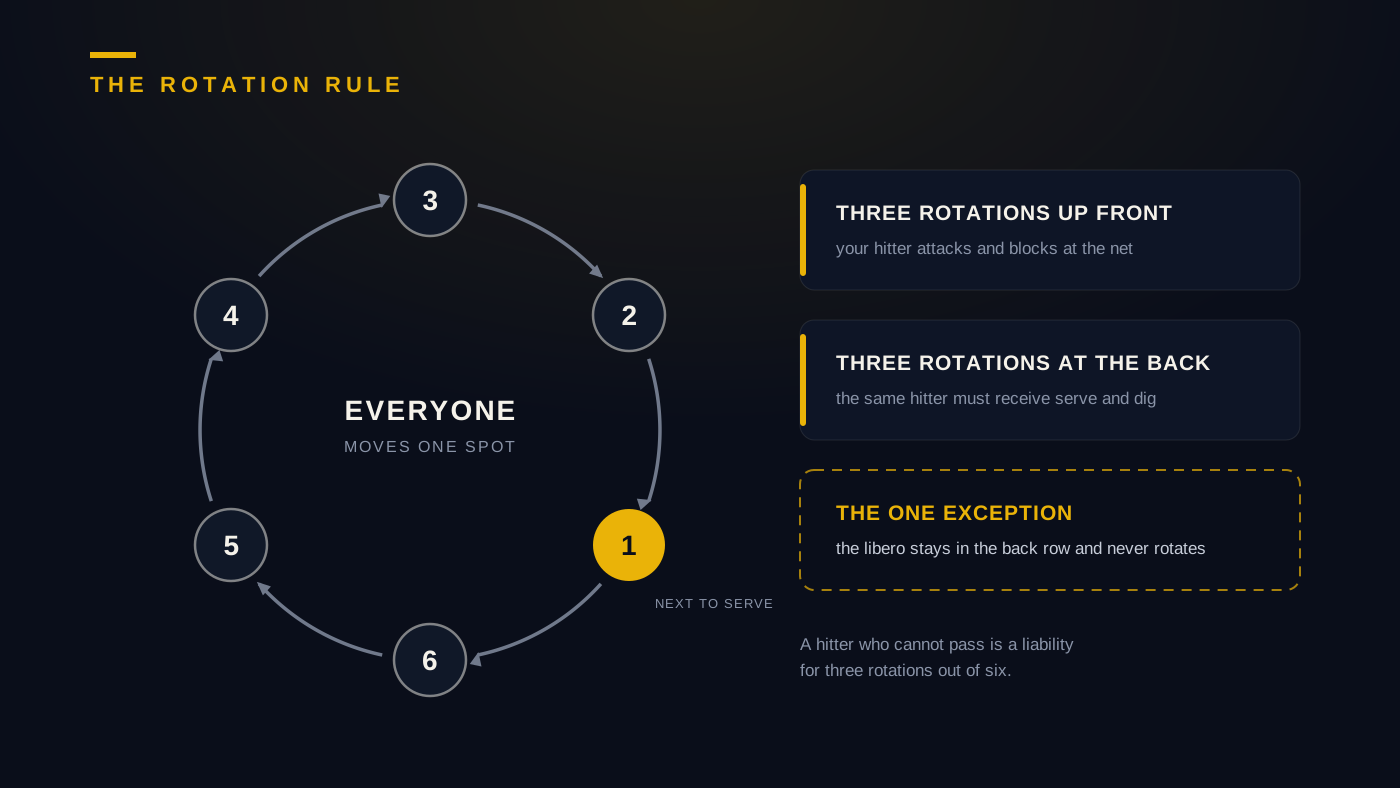
Volleyball players rotate. Except for the libero, everyone passes through all six positions, which means your monster spiker will spend half of every set in the back row, receiving serve and digging. A hitter who cannot pass is a liability for three rotations out of six, and opponents will serve at him relentlessly.
So the smartest money in a volleyball auction does not chase the biggest jump and the loudest spike. It chases complete players: the hitter who also receives well, the middle blocker who can serve, the setter who can block. Tell your captains this openly. It raises the quality of bidding, and it protects the league from the classic mistake where one team buys three spikers, cannot get a ball to any of them and finishes last.
The predictable market on auction night: tall attackers go for too much, setters go for slightly too little and the best libero in the pool is the bargain of the evening. A captain who reads this guide should quietly disagree with the room and buy the spine first: setter, libero, then hitters.
Purse planning for a tight market
Because squads are small, resist the urge to hand out giant purses. A useful starting point is a purse of about sixty to eighty times your base price for a squad of nine. With fewer lots to spread money across, a bigger ratio just inflates every price without adding any real decisions.
Two rules matter more in volleyball than anywhere else:
- Set a per-player cap or steep late increments. With only nine slots, a captain can rationally spend forty percent of the purse on one superstar. If your league finds that fun, allow it. If you would rather have balanced teams, cap the maximum bid or make increments climb steeply at the top end.
- Enforce a squad minimum. Every team must end the night with a full squad it can afford. Software helps here: AuctionXI tracks each purse to the paisa and simply will not let a team bid itself negative, so the awkward moment where a captain has three slots left and money for one player never arrives.
For the deeper maths on ratios and increment ladders, see our guide to base prices, purse and bid increments.
Auction night, volleyball style
Run the standard four-stage structure: setup, main auction, unsold round, wrap-up. A few volleyball-specific touches:
- Auction by category, but rotate categories. A run of setters, then attackers, then liberos, then back again. If every setter sells in the first twenty minutes, teams that missed out lose interest.
- Brief the room on rotation value. Thirty seconds from the host before bidding starts: "remember, everyone except the libero plays back row too." It changes bids.
- Show the market on a big screen. Live purses and squad counts on a projector turn a small-hall auction into an event, and a phone viewer link lets teammates who could not attend follow every bid live.
- Plan the unsold round properly. In small-squad auctions almost nobody stays unsold, because every team needs bodies. Still, decide the reduced base price and the order in advance. Our guide to common player auction mistakes shows what happens when organisers improvise this.
Quick answers for volleyball organisers
Mixed leagues? Corporate volleyball is often mixed, with a rule like two women on court at all times. If that is your format, make women players a visible category and expect them to command a premium, exactly as scarcity predicts.
Beach or 4v4 formats? Everything above scales down. Squads of five or six, an even tighter purse and complete players become the only thing worth buying, since there are no specialists to hide behind.
How do teams get their results? Send every captain the final squads and spending the same night, while the group chat is still buzzing. An export from your auction tool, a full workbook of squads and prices, closes every argument before it starts.
Volleyball gives you the most concentrated auction in team sport: fewer lots, bigger stakes per pick and a market that rewards captains who understand rotation. Set the purse tight, brief the room well and enjoy the fastest two hours in your league calendar. When you are ready, you can set up your tournament and run the whole night from one laptop.