The strange thing about player auctions is how repeatable the failures are. Leagues in different cities, different sports and different budgets all manage to hit the same ten potholes, usually in the same order. Which is good news, because a mistake that is predictable is a mistake you can prevent.

Here are the ten we see most often, each with the fix. Some of them will sound obvious. Every one of them has ruined a real auction night for someone who thought it was obvious too.
1. Deciding the rules on the night
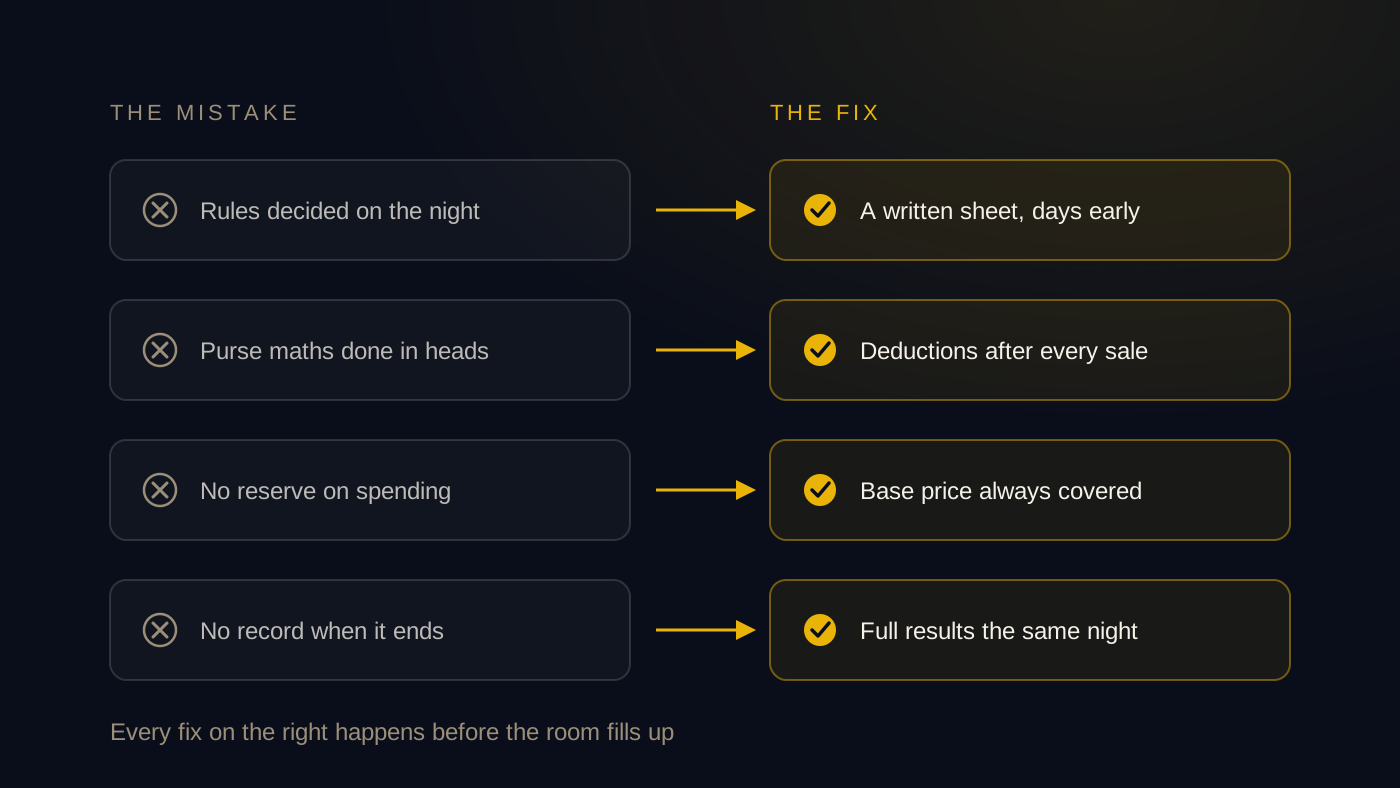
The most expensive sentence in amateur auctions is "we will sort that out if it comes up". It always comes up. Two captains bid simultaneously, someone asks if a bid can be withdrawn or a team hits its squad limit mid-bidding, and now forty people watch the organisers negotiate policy live.
The fix: a written rules sheet, circulated days in advance, covering increments, squad limits, unsold players and tie-break calls. If a situation is not in the sheet, one named referee decides on the spot and the decision stands. The sheet does not have to be clever. It has to exist before the first bid.
2. Doing purse arithmetic in your head
Live subtraction in a noisy room fails quietly. Nobody notices the error at the moment it happens. They notice forty minutes later, when a team wins a player it turns out it could not afford, and now three sales have to be unwound while the room boos.
The fix: never let remaining purses depend on mental maths. On paper, one dedicated scorer updates purses after every single sale and reads them aloud. Better, use a tool where the deduction is automatic. This is the specific problem AuctionXI was built around: purses are tracked to the paisa on every screen in real time and a team simply cannot bid beyond its balance.
3. No reserve rule on spending
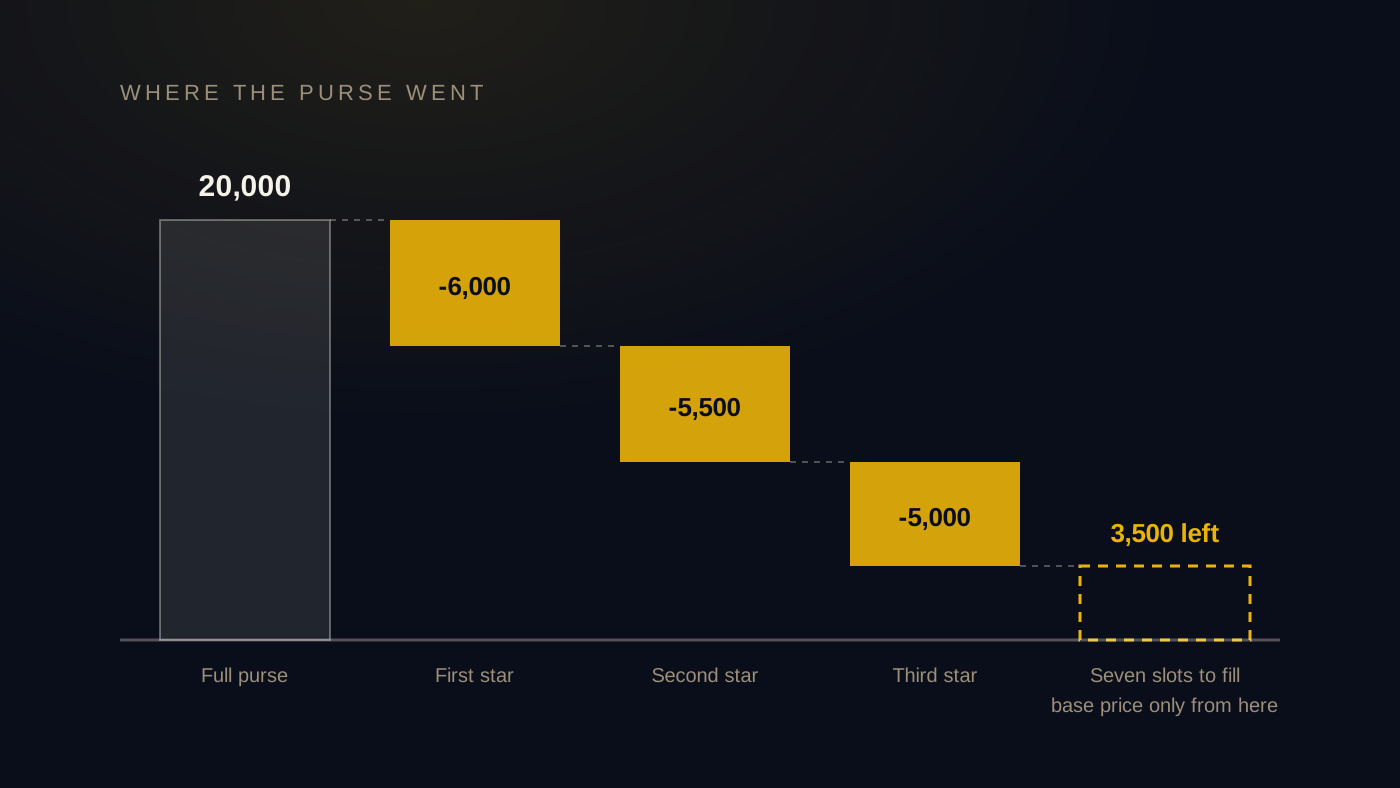
A captain in a bidding war is not thinking about players eight, nine and ten. Without a guardrail, one team torches its purse on three stars, and the back half of your auction becomes a queue of players sold at base price to the only teams still solvent.
The fix: the reserve rule. At every moment, a team must hold enough purse to buy its remaining required players at base price. Publish it, enforce it after every sale and captains will plan around it. How to size the purse itself is covered in our guide to base prices, purses and bid increments.
4. Treating unsold players as leftovers
A player who goes unsold and then gets shrugged into a random team at the end has had a bad night, and bad nights at the auction turn into no-shows at the tournament. Worse is having no policy at all, so unsold players stand around while captains argue about who must take them.
The fix: a proper second round, announced in the rules, usually at half the original base price. Teams with purse and space bid again, and genuinely unsold players are then assigned at base price to the shortest squads. Make round two an event of its own. Some of the best bargains and the loudest cheers happen there.
5. Building the event for five people
If your auction is a laptop, five captains and silence, you have organised a procurement meeting. The players whose names are being called are at home, and the biggest marketing moment your tournament will ever have is happening in a closed room.
The fix: make it a spectator event on purpose. Big screen, players invited, a compere who plays to the crowd. Let remote players watch live on their phones if your tool offers a viewer link. A player who watched two teams fight over him will tell that story for a year, and next season your registration fills itself.
6. Collecting player data at the last minute
The auction can only announce what registration collected. Leagues that open the form five days before the event get a list with missing roles, missing photos and three spellings of the same player. The auctioneer then spends the night saying "next we have, umm, Ramesh, who plays, umm".
The fix: open registration three to four weeks out, keep the form short, make role a fixed choice and make the photo mandatory at submission. Our guide to player registration for auctions covers the exact fields worth collecting and the photo rules that actually get followed.
7. One flat price and one flat step for everyone
Flat base prices insult your best players and expose your newest ones, and a single flat increment is wrong at both ends: painfully slow for stars, brutally fast for budget picks. The result is a first hour that drags and a last hour of unsold names.
The fix: three player categories with meaningfully different base prices, and an increment ladder where steps grow as the price climbs. Small steps early, bigger steps at higher amounts. It is one evening of setup work and it changes the texture of the whole night.
8. Losing the pace
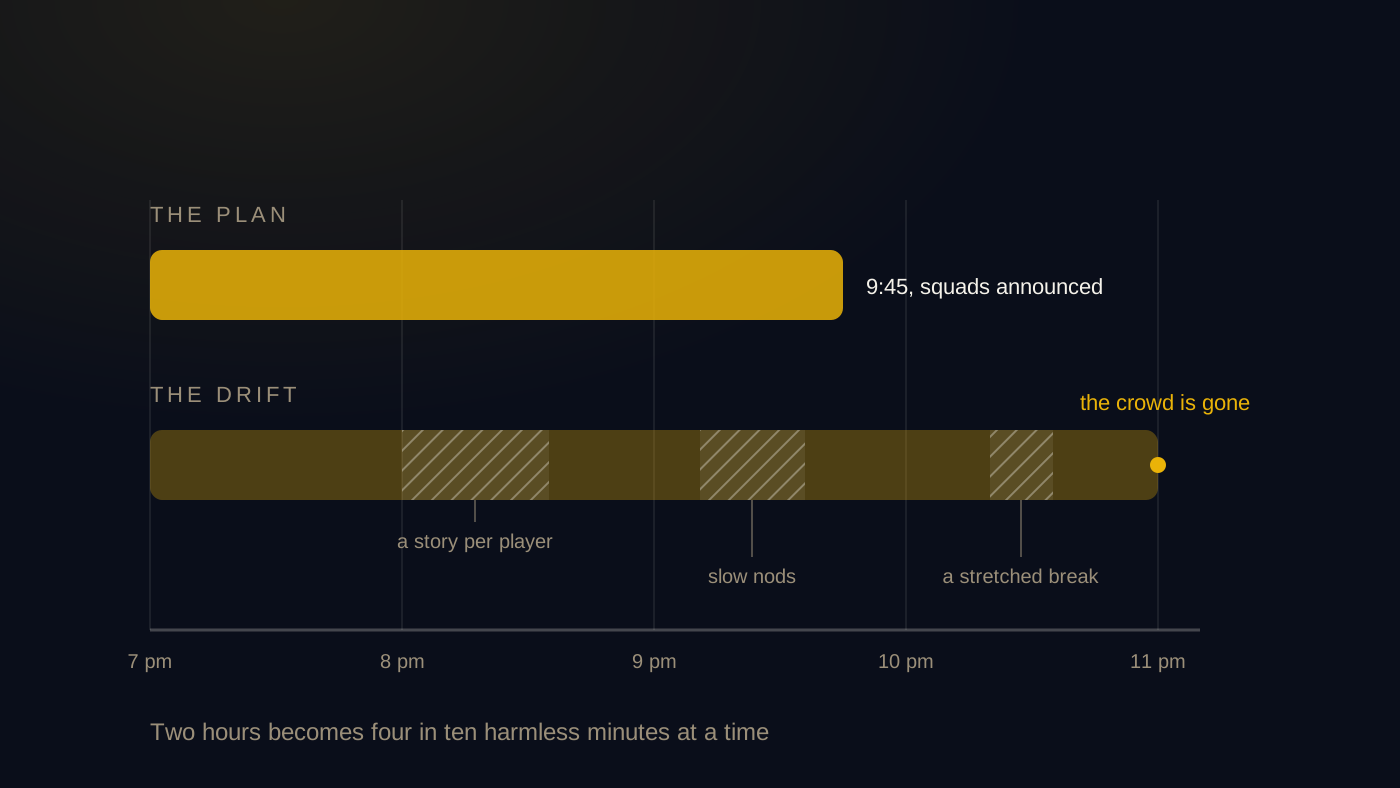
Auctions die at the speed of their slowest habit. A compere who tells a story per player, captains who take a minute per nod, a break that stretches to thirty minutes. Individually harmless, together they turn a two-hour event into a four-hour siege, and the crowd you worked to attract leaves before the best round.
The fix: target roughly ninety seconds per player and give the auctioneer authority over tempo, including a counted "going once, going twice" that actually closes. Cap the break at ten minutes. Put the marquee categories first while attention is at its peak.
9. Handling mistakes without a script
Errors happen in every auction: the wrong player is brought up, a sale is recorded against the wrong team, a bid is entered as 5,000 instead of 500. What sinks the evening is not the error. It is five organisers whispering around a laptop while the room invents its own version of events.
The fix: a correction script agreed in advance. The referee announces the error immediately, states the correction and the purses are fixed in the open before the next player comes up. Software helps here too. AuctionXI keeps a 15-second undo for exactly these moments, so a slip becomes a chuckle instead of a committee.
10. Ending the night with no record
The auction ends, everyone leaves happy, and then Tuesday arrives. Who exactly is in the Thunderbolts squad? What did the Cobras pay for their keeper? If the answer lives on a whiteboard photo taken at an angle, every disagreement for the rest of the season is unresolvable.
The fix: publish the complete results, every player, every team, every price, to all captains the same night. If your tool can export the full auction as an Excel workbook, send that. If you ran it on paper, type it up before you sleep. The record you share at 11 pm prevents the arguments of the next three months.
The pattern behind all ten
Read the list again and one theme repeats: almost nothing on it happens during the auction. Rules, reserve, registration, categories, pace plan, correction script, records. They are all decisions you either made in the quiet week before or improvised in the loud room later. The organisers who look calm on auction night are not calmer people. They just moved the hard work earlier, and our auction day checklist is the week-before companion to this list.
Manual methods can honestly clear all ten hurdles for a small auction if you are disciplined about them. As rooms get bigger and bidding gets faster, more of the list is worth automating, which is why purpose-built platforms exist and why you can set one up for a single tournament without signing up to anything ongoing. Either way, avoid these ten and you are already running a better auction than most leagues ever see.