Two rules cause more pre-auction WhatsApp debate than everything else combined: Right to Match and what happens to unsold players. One is a piece of IPL glamour that most local leagues copy without thinking about, and the other is the unglamorous rule that decides whether every player who registered actually gets to play. This guide explains both, tells you honestly when you need them and gives you formats that work at local level.
If you are still writing your overall rulebook, our complete guide to cricket auction rules covers everything from purses to squad caps. This article goes deep on just these two.
What Right to Match actually is
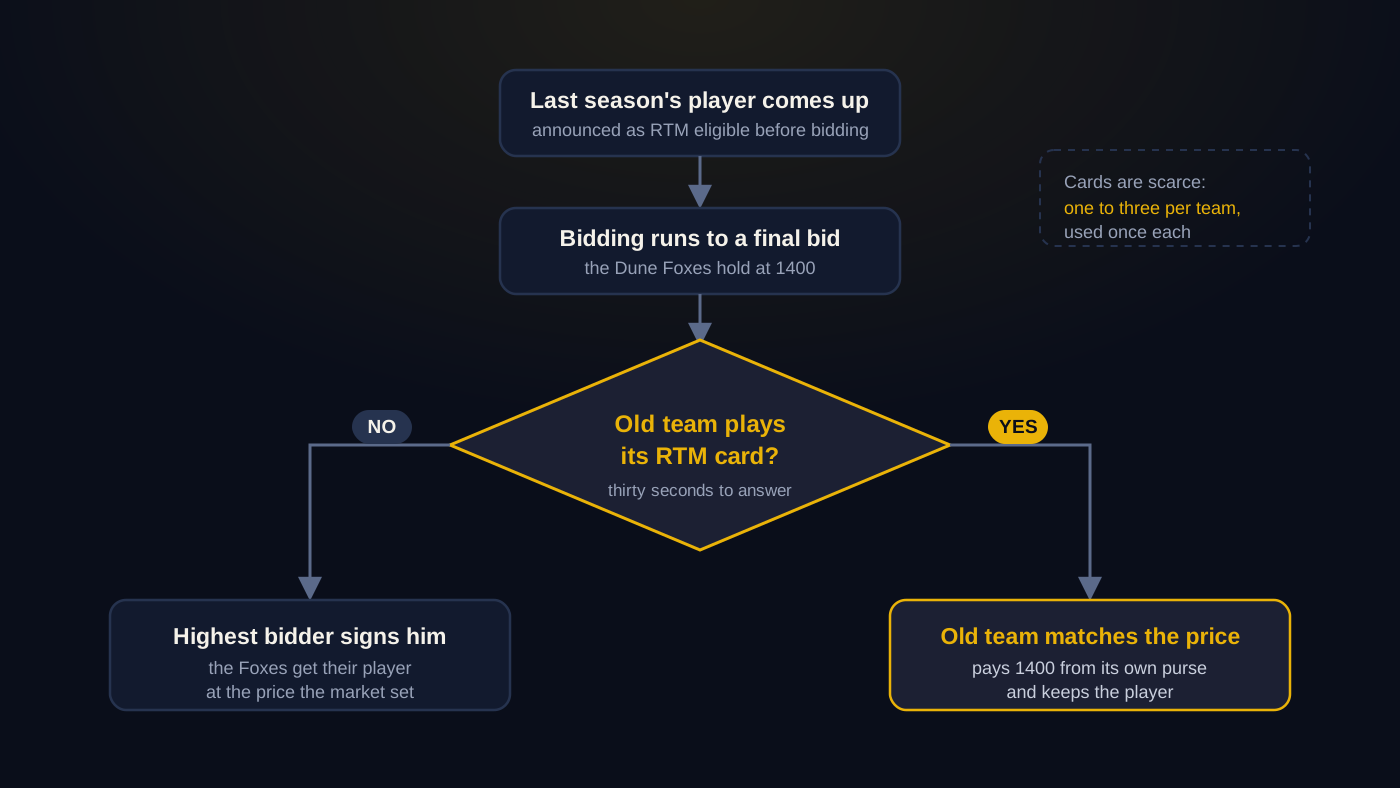
Right to Match, usually shortened to RTM, is a rule the IPL uses in its mega auctions. The idea is simple. When a player who played for a team last season comes up for auction, the bidding runs normally. Once the final bid lands, the player's old team gets one question: do you want to match that price? If they say yes, they pay the final bid amount and keep the player. If they say no, the highest bidder gets him.
The point of RTM is continuity. Big auctions reset all the squads, and RTM lets a team hold on to a couple of players they built around, without exempting those players from the market. The player still gets a market price. The old team just gets the last word.
A worked example with invented teams. Suppose the Copper Giants had a star all-rounder last season. This year he enters the auction at a base price of 500. The Dune Foxes and the Tidebreakers push him to 1400, with the Foxes holding the final bid. The Giants now use their RTM card: they pay 1400 from their own purse and keep him. The Foxes get nothing, which is exactly why RTM cards are limited in number, usually one to three per team.
Does your local league actually need RTM?
Here is the honest answer: probably not in season one, and only sometimes after that.
RTM exists to solve a problem your league may not have. It matters when teams have identity and history, when the same franchises return year after year and fans associate players with teams. In a first-season office cup or society tournament, no team has a "last season", so there is nothing to match. Adding RTM there is copying the costume without the reason.
Where RTM earns its place at local level:
- Returning leagues with fixed franchises. If the Stormhawks have existed for four seasons and their captain has built a core, one RTM card per team keeps some continuity without killing the market.
- Leagues where team owners invest real money. Owners who fund a team across seasons reasonably want a way to protect one key player.
Where it causes trouble:
- It slows the auction. Every RTM moment adds a pause and a decision. Ten of them add half an hour.
- It confuses casual rooms. If half your captains are hearing the rule for the first time on auction night, someone will use it wrong and someone will feel cheated.
- It weakens the drama. The best part of an auction is that anyone can be bought. RTM blunts that.
If you do adopt it, three guardrails: limit cards to one or two per team, announce before bidding starts whether a player is RTM-eligible and require the answer within thirty seconds. A good anchor makes the RTM moment theatrical rather than slow, and our anchor script and hosting guide shows how to build those pauses into the night.
Unsold players: the rule that actually matters
Every auction has unsold players. A player goes unsold when the bidding opens at base price and no captain raises a paddle. It is normal, it is not an insult and it is going to happen to somewhere between five and twenty percent of your pool, usually the players captains know least.
What is not acceptable is having no plan for them. These are people who registered, paid their fee in many leagues and turned up expecting to play. The unsold rule is where your auction proves it is fair. Decide the whole procedure before auction day and put it in the rulebook you share with captains.
How to run unsold rounds
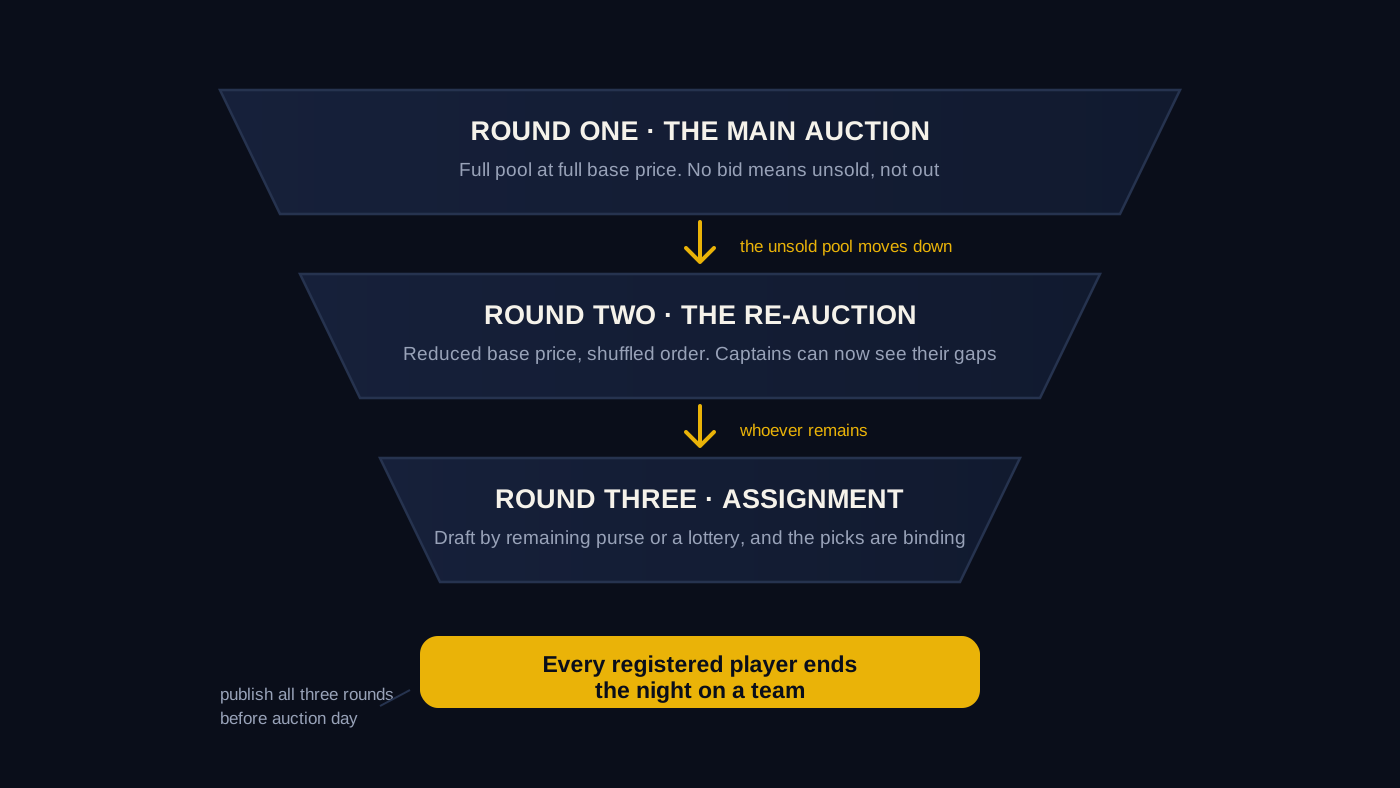
The standard structure has three passes.
Round one: the main auction
Run the full list. When a player receives no bid at base price, the anchor calls "unsold", the player goes into the unsold pool and the auction moves on. Two habits help here. First, keep the moment quick and warm rather than letting silence hang. Second, make sure the unsold pool is visibly tracked so nobody is forgotten. If you are running the night on AuctionXI, unsold re-auction rounds are supported out of the box, so nobody has to maintain a side list on paper while the room shouts.
Round two: the re-auction
After the main list finishes, bring the unsold pool back. This round works because the market has changed: captains can now see their gaps. A team that ended round one without a wicketkeeper will suddenly bid hard for one it ignored two hours earlier.
Most leagues cut base prices for this round, and it works. A common approach is halving the base price, so a player who found no takers at 500 re-enters at 250. Some leagues drop everyone to a single floor price instead, say 100 for all unsold players regardless of category. Both are fine. What matters is announcing the reduction rule in advance so it never looks like improvisation. If you are unsure how the numbers interact, our guide to base price, purse and bid increments walks through the arithmetic.
Order matters too. Shuffle the unsold pool or sort it by role rather than repeating the original order. The player who went unsold first should not have to go unsold first twice.
Round three: assignment
After the re-auction some players may still be unsold, and some teams may still be short of the squad minimum. Now you assign. The usual methods, in order of popularity:
- Draft order by remaining purse. The team with the most purse left picks first from the remaining pool, paying base price. Then the next richest, and so on until every team reaches the minimum squad size.
- Lottery. Names in a bowl, teams draw in turn. Purely random, impossible to argue with, slightly less strategic.
- Organiser assignment for balance. The organiser places the last few players to even out squads. This works only if the organiser is trusted and neutral, so use it as a last resort.
Whichever method you use, the destination rule is the same and it should be printed in bold in your rulebook: every registered player ends the night on a team. A league that leaves people teamless after taking their registration does not get a season two.
Three edge cases to decide in advance
- A team's purse runs out before the squad minimum. Standard fix: assigned players beyond the purse cost nothing, or the minimum bid is waived for that team. Decide now, not at 11 pm.
- A player withdraws after going unsold. Allow it gracefully, remove them from the pool and adjust the assignment count.
- A captain wants to "pass" on an assigned player. No. Assignment rounds are binding, otherwise the least-known players get passed around the room, which is exactly the humiliation the rule exists to prevent.
The short version
Skip RTM in your first season and adopt it later only if your league has real franchise continuity, with one or two cards per team and a thirty-second clock. For unsold players, run a re-auction at reduced base prices, assign whoever remains so every player gets a team and publish all of it before auction day. Tools help with the bookkeeping: AuctionXI tracks every purse to the paisa through all three rounds and never lets a team go negative, and you can set up a tournament with these rounds in minutes. But the fairness itself comes from deciding the rules early and writing them down. That part is on you, and it is the part your players will remember.