Two auctions can have the same players, the same purse and the same rules, and one becomes the night everyone talks about for a year while the other dies quietly by player number twenty. The difference is almost always the person holding the microphone. A good anchor turns a list of names into a show. This guide gives you a working structure for the evening, a sample script skeleton you can adapt and the stagecraft habits that keep a room alive for two hours.

If you are still setting up the auction itself, start with our guide to running a cricket player auction and come back here for the hosting side.
What the anchor's job actually is
The anchor is not just an announcer of names. On auction night you are three people at once.
- The referee. You confirm every bid out loud, you settle who bid first and your sold call is final. If the room does not trust your calls, bidding turns into arguing.
- The storyteller. Every player deserves a moment. One good line before the bidding opens is the difference between a player being fought over and a player being waved through.
- The clock. Nobody else in the room is watching the pace. You are. Ninety seconds per player is the rhythm to protect.
Notice what is not on the list: the maths. The anchor should never be adding purses in their head. Give that job to a separate operator with a spreadsheet or software. If the operator is running something like AuctionXI, every purse updates on the screen in real time and can never go negative, so you can call bids as fast as the room throws them without ever stopping to check whether a team can afford it.
The evening as a script
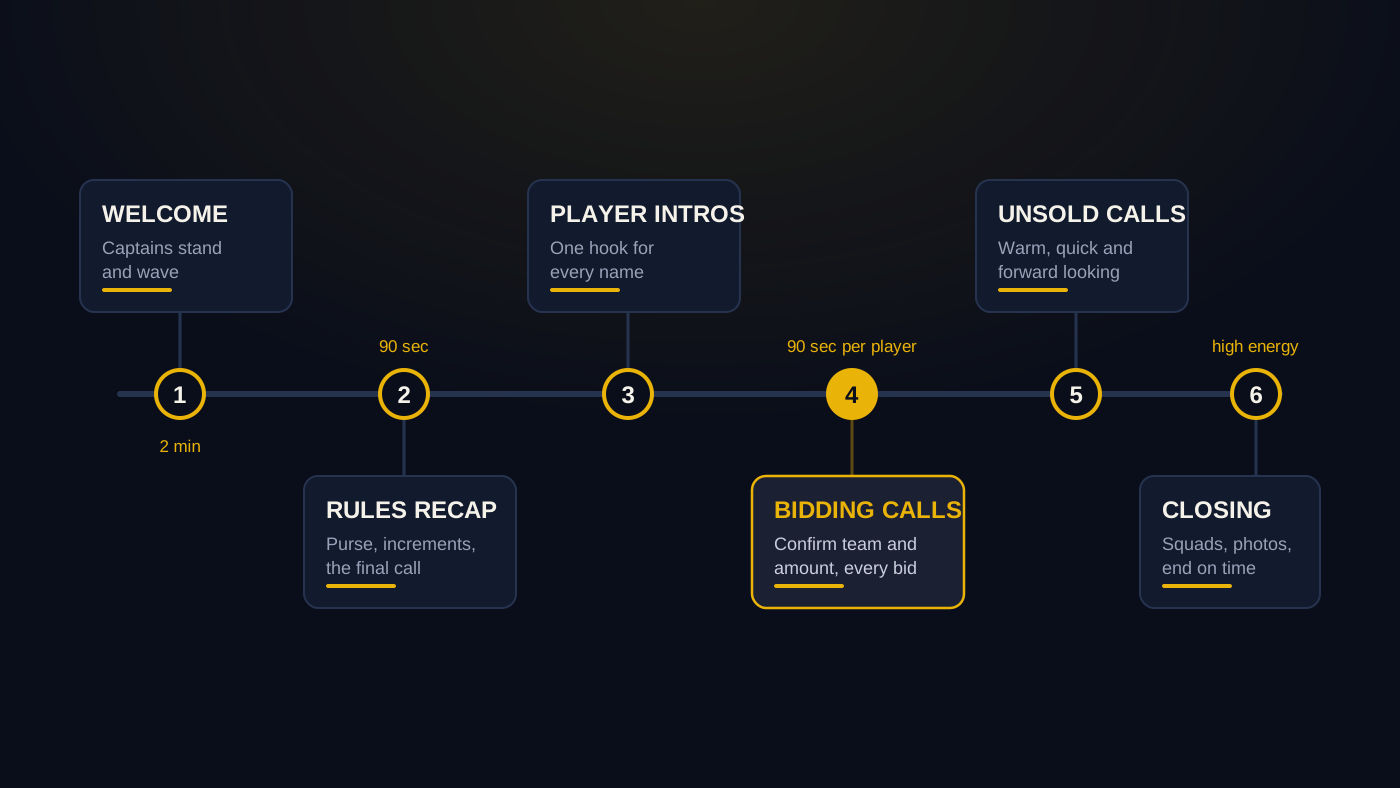
Think of auction night in six scenes. Write your own version of each before the day, even if it is just bullet points on a card.
Scene one: the welcome
Two minutes, no more. Welcome everyone, thank the ground or clubhouse that gave you the room, name the sponsors if you have them and introduce the captains one by one. Get each captain to stand and wave. This tiny bit of theatre matters: it tells the room who the characters of the evening are.
Scene two: the rules recap
Even if you shared the rules a week ago, recap them in ninety seconds: the purse, the bid increments, the squad size, what happens to unsold players and that the anchor's call is final. Say that last one clearly and with a smile. You will lean on it later.
Scene three: player introductions
This is the heart of the night and where most first-time anchors go flat. Reading "Player 14, batsman, base price 500" forty times in a row will empty any room. Every intro needs one hook: a role, a reputation or a friendly tease.
Scene four: the bidding calls
Confirm every bid by team and amount: "700 from the Stormhawks. 750, Tidebreakers. 800 back to the Stormhawks." Then the countdown: "800 once. 800 twice. Sold to the Stormhawks for 800!" Say the winning team and price loudly every single time, because that sentence is what the operator enters and what the room remembers.
Scene five: unsold calls and the second round
When nobody bids, do not let it feel like a funeral. Keep it warm and forward-looking: "No takers at this price tonight, which means someone gets a bargain in the second round. We will see him again." Then move on quickly. We cover the mechanics of re-auction rounds in our guide to Right to Match and unsold player rules.
Scene six: the closing
Announce each final squad, invite the captains up, take the photos and end on time. A crisp closing at high energy beats a long one at low energy every night of the week.
A sample script skeleton
Here is a fully original skeleton you can adapt. Every name in it is invented.
Welcome: "Good evening and welcome to the fourth season of the Riverside Premier Cup! Eight captains, one hundred and twelve players and every purse starts equal. Captains, on your feet: the Stormhawks, the Tidebreakers, the Dune Foxes, the Copper Giants..."
Rules recap: "Quick rules. Base price opens the bidding. Increments of 50 up to 1000, then 100 after that. Twelve players per squad, no more, no fewer. Unsold players return in round two. And the golden rule: my hammer is final, my jokes are optional."
Player intro: "Next up, from the Sunday nets legends, Player 23. Opening batter, hits the first ball of every innings like it insulted his family. Base price 500. Who starts us off?"
Bidding: "500 from the Dune Foxes. 550, Copper Giants. 600, Foxes again. Any advance on 600? 600 once... 600 twice... sold to the Dune Foxes for 600!"
Unsold: "No bids tonight at 500. He goes into the second round pool, and mark my words, someone is getting a steal."
Closing: "That is one hundred and twelve players sold, eight squads locked and one very tired anchor. See you at the ground on Saturday. Good night, Riverside!"
Print it large, double-spaced, one player per line. You will thank yourself when the room is loud.
Writing player intro lines
You need a one-liner for every player, and forty good one-liners do not appear on stage. Write them beforehand. Three reliable templates:
- The role line. "A left-arm spinner who bowls the overs nobody else wants." Simple, useful to captains and always safe.
- The reputation line. "Last season's leading run scorer in this very tournament." Only use claims the room knows to be true.
- The affectionate tease. "Bats at three, fields at fine leg and appeals from anywhere." Teasing works when it is warm. Never joke about a player's weight, age or last season's failure. The line should make the player grin, not shrink.
If your registration form collected a fun fact or a self-description, mine it. One honest detail beats three invented ones.
Managing pace and energy
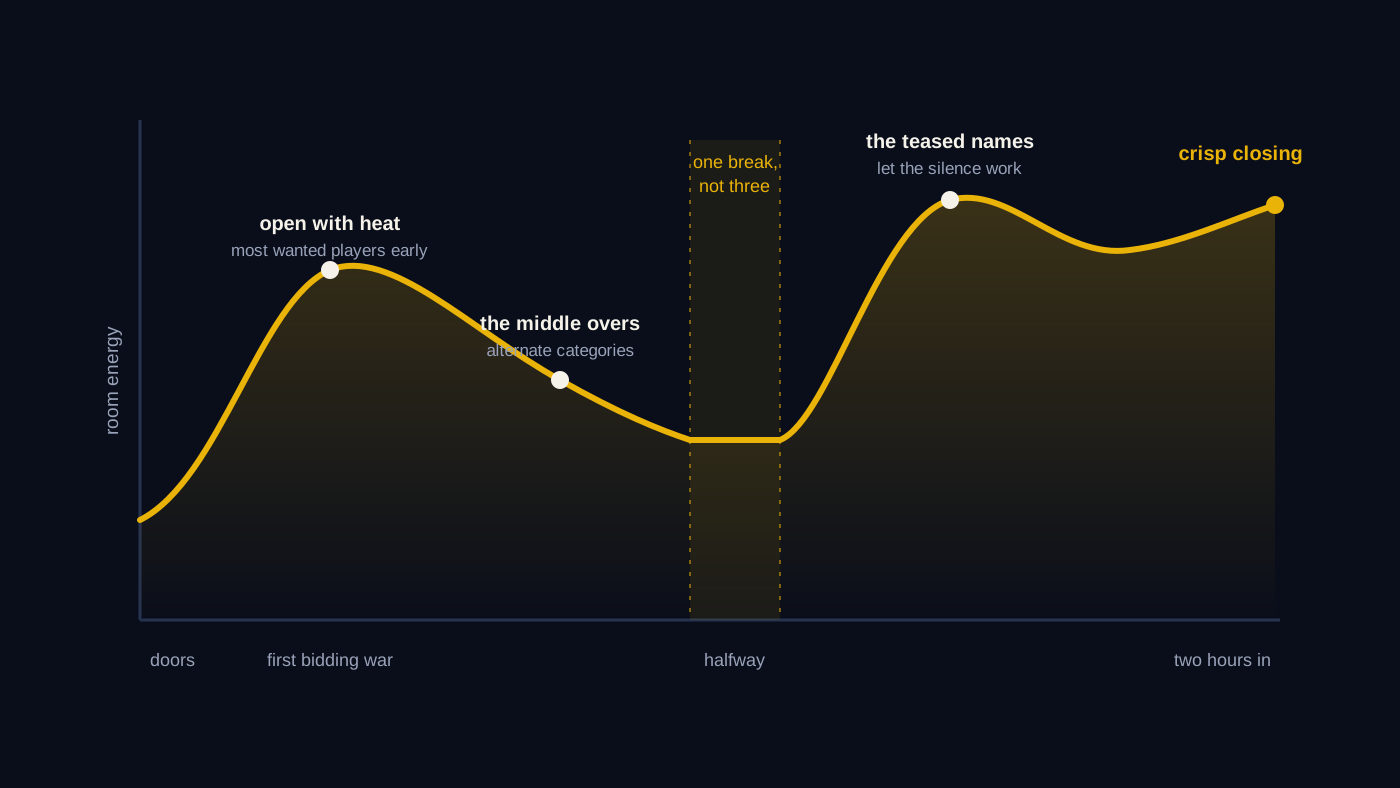
A two-hour auction has a shape, and the anchor's job is to manage it like a bowler manages a spell.
- Open with heat. Put four or five of your most wanted players early. The first bidding war sets the room's temperature for the night.
- Never stack the dull stretch. Alternate categories so the room does not sit through fifteen similar players in a row.
- Take one break, not three. Around the halfway mark, ten minutes, announced with a teaser: "When we return, the two most requested players in the pool."
- Slow down for the big moments. When a bidding war catches fire, stop rushing. Repeat the number, look at the other captain, let the silence work. Drama needs room to breathe.
- Speed up everything else. Between sales, no dead air. Player sold, next name up, base price, go.
Watch the room, not your script. Phones coming out means you are too slow. Captains asking you to repeat numbers means you are too fast.
Working with the screen behind you
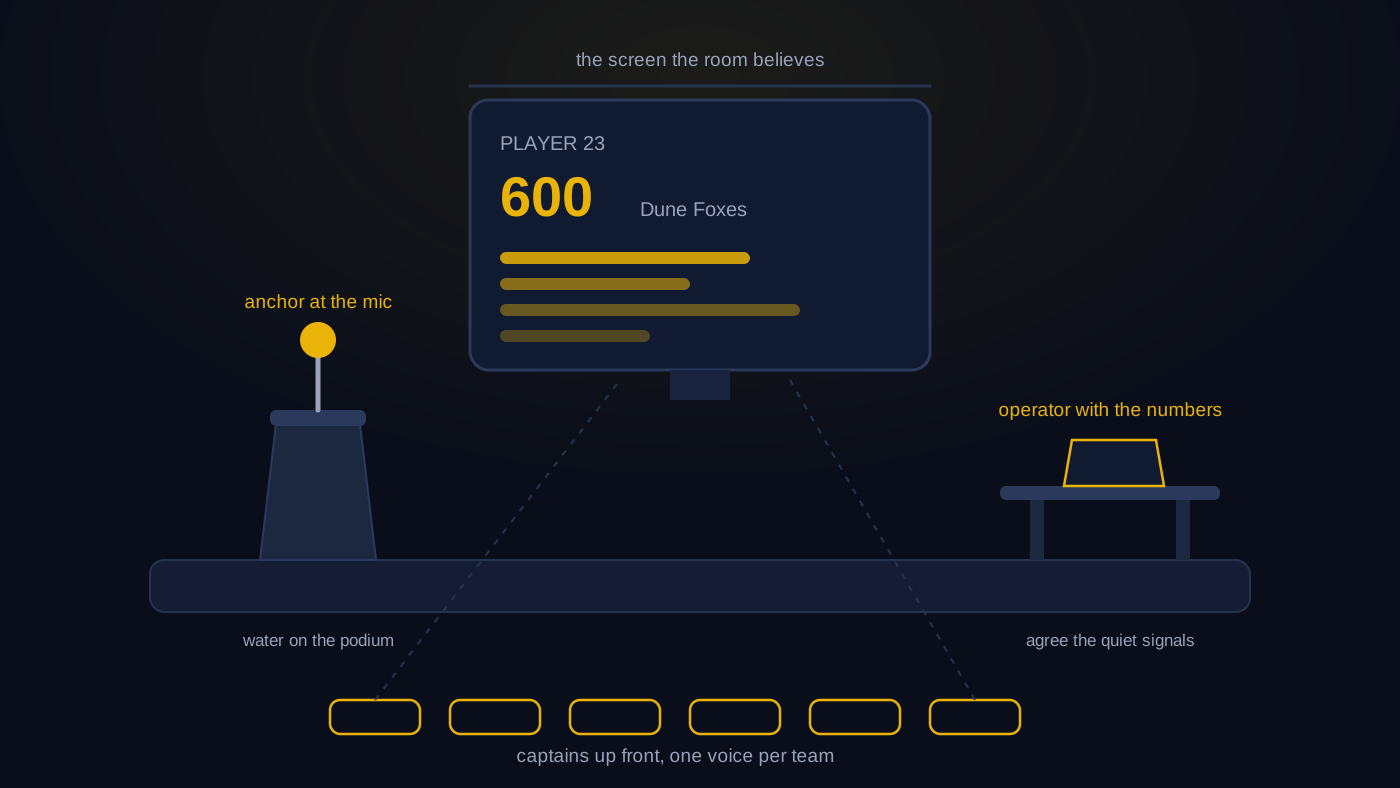
Whatever the anchor says, the room believes the screen. Make sure they agree. Before doors open, rehearse five minutes with your operator: you call a sale, they enter it, the screen updates. Agree a quiet signal for "wait" and one for "we entered it wrong". Mistakes happen in loud rooms, which is why AuctionXI gives operators a 15-second undo, so a mis-clicked sale is reversed before the room even notices. If you are projecting the auction for the audience, our guide to broadcasting your auction on a projector and YouTube covers the setup.
One last thing. Eat before the auction, keep water on the podium and decide your final line in advance. The anchor who ends the night with a clear voice and a planned closing sentence is the anchor who gets invited back next season. And that, more than any bidding war, is how you know you did it well.