
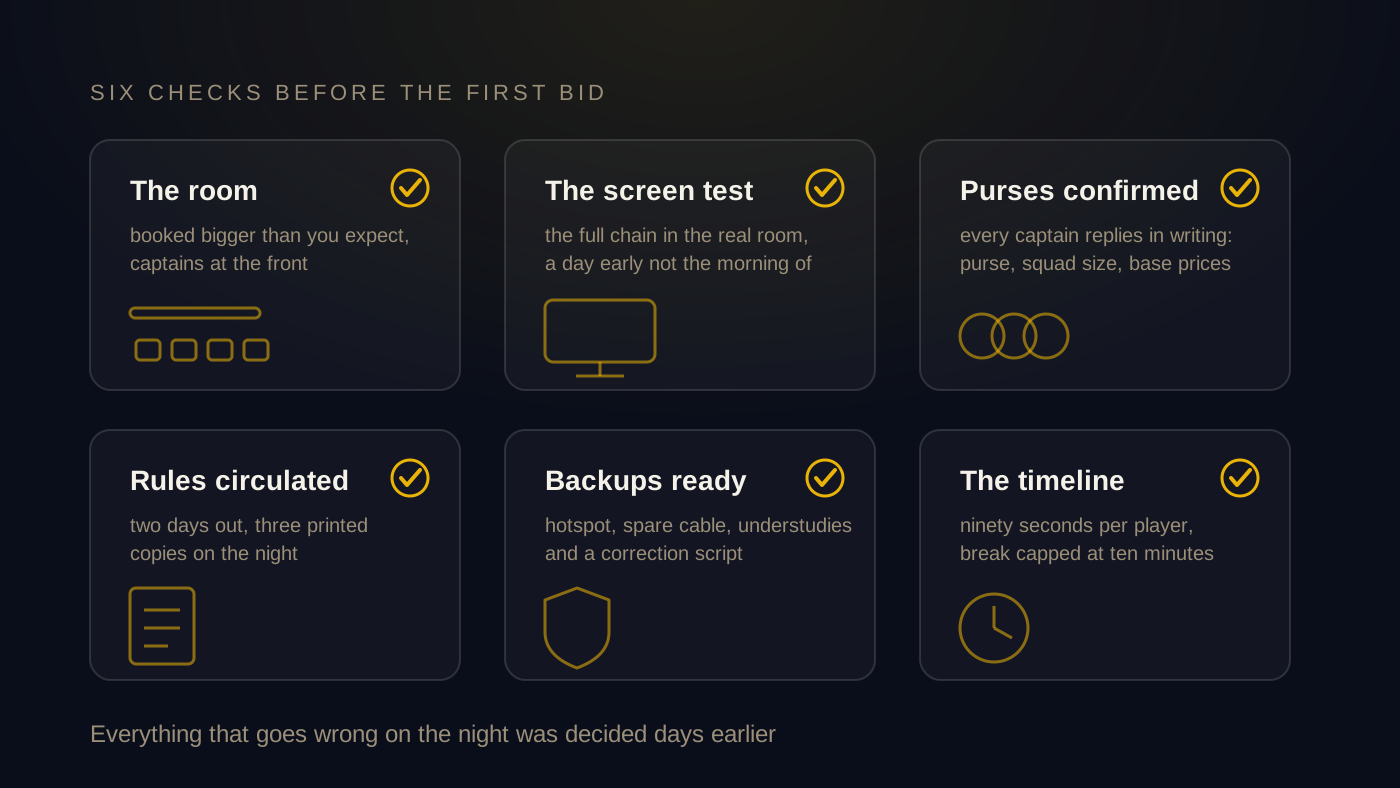
Auction night has a strange property: everything that goes wrong on the night was actually decided days earlier. The projector that will not talk to the laptop, the captain who thought his purse was bigger, the argument about increments in round three. None of these are auction problems. They are preparation problems that waited until the room was full to introduce themselves.

This is the checklist we would hand any first-time organiser. Work through it in order: the room, the screen, the numbers, the rules, the backups and finally the timeline for the evening itself. If you have not planned the auction structure yet, start with our guide on how to run a cricket player auction and come back here for the final week.
The room
Book a room for more people than you expect. Auctions grow. Captains bring co-captains, players bring friends and the tournament group decides at 6 pm that everyone is coming. A tight room gets loud and hot fast, and a loud hot room makes bad bidding decisions.
Check these in person, not over the phone:
- Seating layout. Captains at the front, one table per team, all facing the screen. Bidders who cannot see the screen or each other slow everything down. The crowd sits behind.
- Sound. Can a person at the back hear the auctioneer without shouting? If the room is bigger than a large living room, you want a mic and one speaker. Test it with music playing, because that is the noise level of a real auction.
- Power. Enough sockets near the organiser table for a laptop, the projector and phone chargers. Bring an extension board anyway.
- Basics. Drinking water, working fans or AC and a plan for tea or snacks at the break. A comfortable room bids longer and complains less.
The screen test
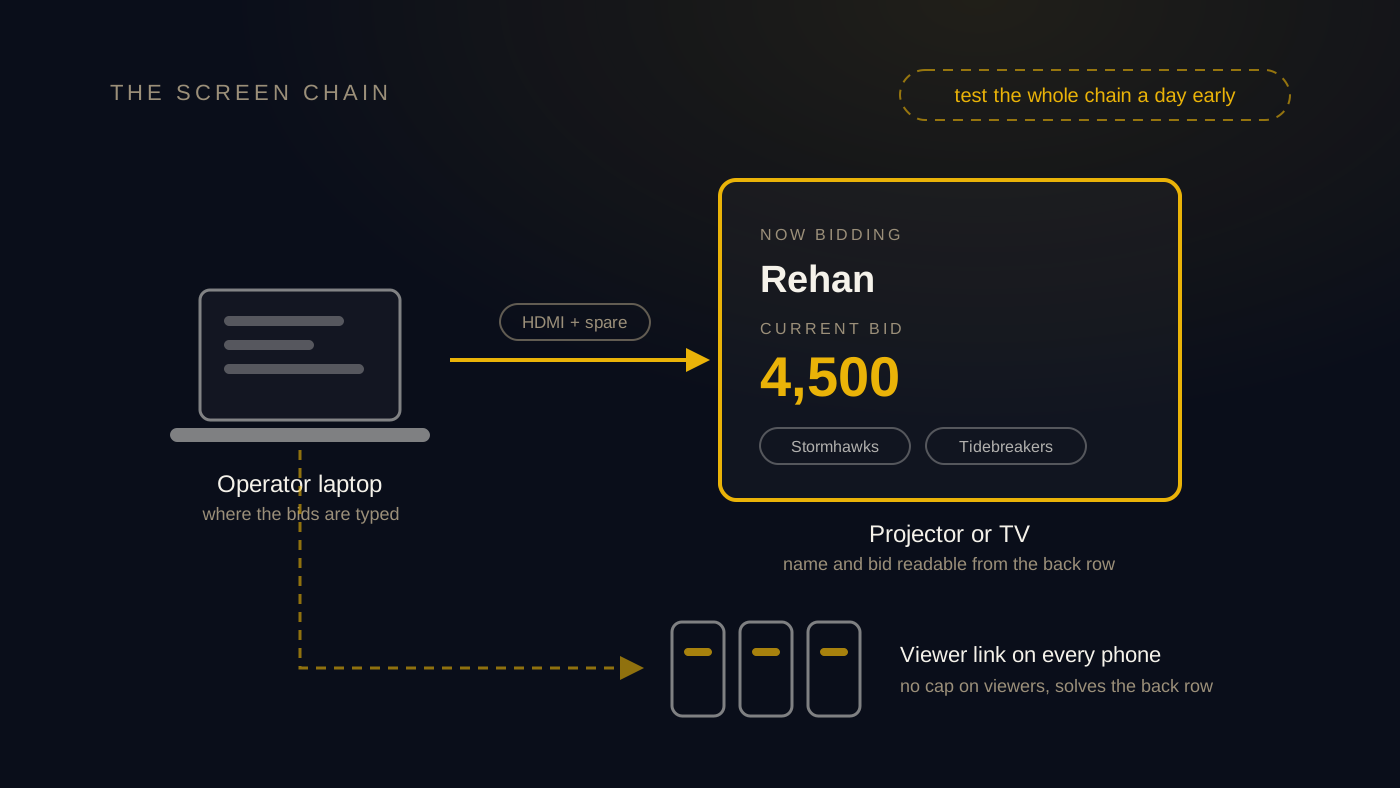
The big screen is the heart of the event, so test the full chain, laptop to cable to projector or TV, in the actual room at least a day before. Not the morning of. A day before, so there is time to buy the adapter that is inevitably missing.
Test the real content, not a desktop wallpaper. Put the actual auction view on screen and walk to the back row. Can you read the player name and the current bid from there? Small fonts that look fine on a laptop vanish on a projector across a bright room.
If you are running your auction on software, check how it wants to be displayed. AuctionXI gives you a dedicated projector link, a separate screen that just shows the live auction full-size, so the laptop the operator types on is not the screen the room watches. It also gives the audience a viewer link that anyone can open on their own phone with no cap on viewers, which quietly solves the back-row problem and lets players who could not attend follow along live. If you plan to stream the night or overlay it on a camera feed, that is its own small setup with its own test, and our guide to broadcasting your auction on a projector or YouTube walks through it.
Whatever your setup, do a ten-minute mock auction during the test: bring up three players, place bids, sell them. A dry run finds the awkward step no checklist can predict.
The numbers: purse confirmation
Every captain must confirm three numbers in writing before the day: their total purse, the squad size and the base price structure. In writing matters. "I thought the purse was 25,000" at player forty is one of the classic auction meltdowns, and it is unanswerable unless there is a message on record saying 20,000.
Send one message to the captains' group the day before with the purse, squad size, category base prices and the increment ladder, then ask each captain to reply confirming. It takes two minutes and it converts every future dispute into a scroll-up.
While you are at it, verify the player list one last time: every registered player present in the system, categories correct, photos attached, no duplicates. If your list still has gaps, fix them tonight. Auction morning is for setup, not data entry.
The rules, circulated
The rules document does not need to be long, but it needs to exist before the day and everyone bids under the same one. It should cover:
- Base prices per category and the increment ladder.
- Minimum and maximum squad size plus any composition rules.
- The reserve rule: a team must always be able to afford its remaining required players at base price.
- What happens to unsold players, including whether there is a second round at reduced base price and whether right-to-match cards are in play.
- Who has the final call on a disputed bid. One named person. Disputes settled by committee mid-auction take twenty minutes each.
Circulate it at least two days out and bring three printed copies on the night: one for the auctioneer, one for the organiser table and one spare.
Backup plans
You do not need a backup for everything. You need a backup for the four failures that actually happen:
- The internet dies. Know the venue wifi password and have a phone hotspot tested and charged as the fallback. Test the auction actually running on the hotspot, not just a connected laptop.
- The projector dies. A large TV in the venue, a spare HDMI cable and, in the worst case, the audience viewer link on everyone's phones will carry the night.
- A person is missing. If the auctioneer or a captain is stuck in traffic, who steps in? Name the understudies in advance. Any captain can send a deputy with full bidding authority as long as it is one person.
- A mistake is made. A player sold to the wrong team or a bid recorded wrong. Decide now how corrections work. On paper, the auctioneer announces the correction immediately and both purses are fixed in the open. On AuctionXI there is a 15-second undo for exactly this moment, which is usually the difference between a laugh and an argument.
The timeline for the evening
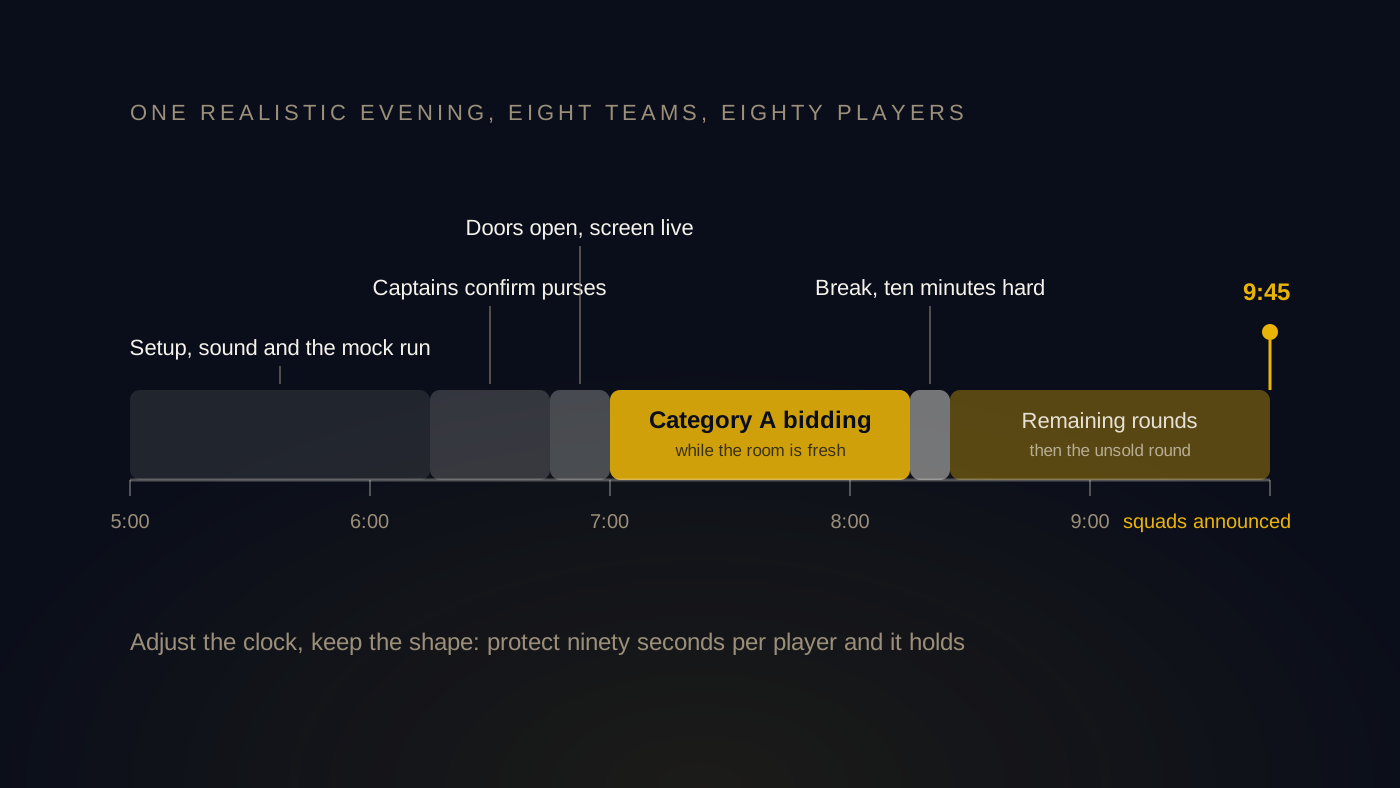
Here is a realistic schedule for an eight-team, eighty-player auction starting at 7 pm. Adjust the clock, keep the shape.
- 5:00 pm. Organiser and one helper arrive. Room layout, power, sound check, screen chain connected and mock auction run.
- 6:15 pm. Captains arrive. Each captain confirms their purse on the screen, gets their seat and asks their last questions.
- 6:45 pm. Doors open for players and crowd. Something on the big screen, even just the tournament name and sponsor slides, so the room feels live.
- 7:00 pm. Welcome, two-minute rules recap by the auctioneer, then straight into Category A. Never open with announcements longer than five minutes. The room came for bidding.
- 8:15 pm. Break after roughly half the list. Ten minutes, hard limit. Captains regroup, purses get studied, tea happens.
- 8:25 pm. Remaining categories, then the unsold round.
- 9:45 pm. Final squads announced on screen, team photos, thanks to sponsors. Share the full results with all captains the same night. If your software exports the final squads and spending as a workbook, send it before everyone leaves the parking lot.
The pace to protect is roughly ninety seconds per player. The auctioneer controls that more than anyone, and a good one is worth rehearsing with. Our auction anchor script and hosting guide has lines and pacing for exactly this job.
The one-line version
Do the screen test a day early, get every number confirmed in writing, circulate the rules, prepare four backups and guard the timeline. Small auctions run honestly on paper and discipline. Bigger rooms are where organisers move to purpose-built software, which is paid once per tournament rather than by subscription. Either way, an auction that was prepared like this feels effortless on the night, and effortless is the whole trick.