
Badminton might be the most auction-friendly racquet sport there is, and almost nobody has noticed yet. Corporate leagues, housing society championships and club leagues across India are moving to the franchise format: teams with owners, a live player auction and a season of ties. If you are organising one, this guide is for you, because a badminton auction is genuinely different from every team-sport auction, and copying a cricket template will get your captains into trouble.
The difference comes down to one thing: in badminton, you are not buying a team. You are buying a set of event slots.
A badminton squad is a puzzle, not a list
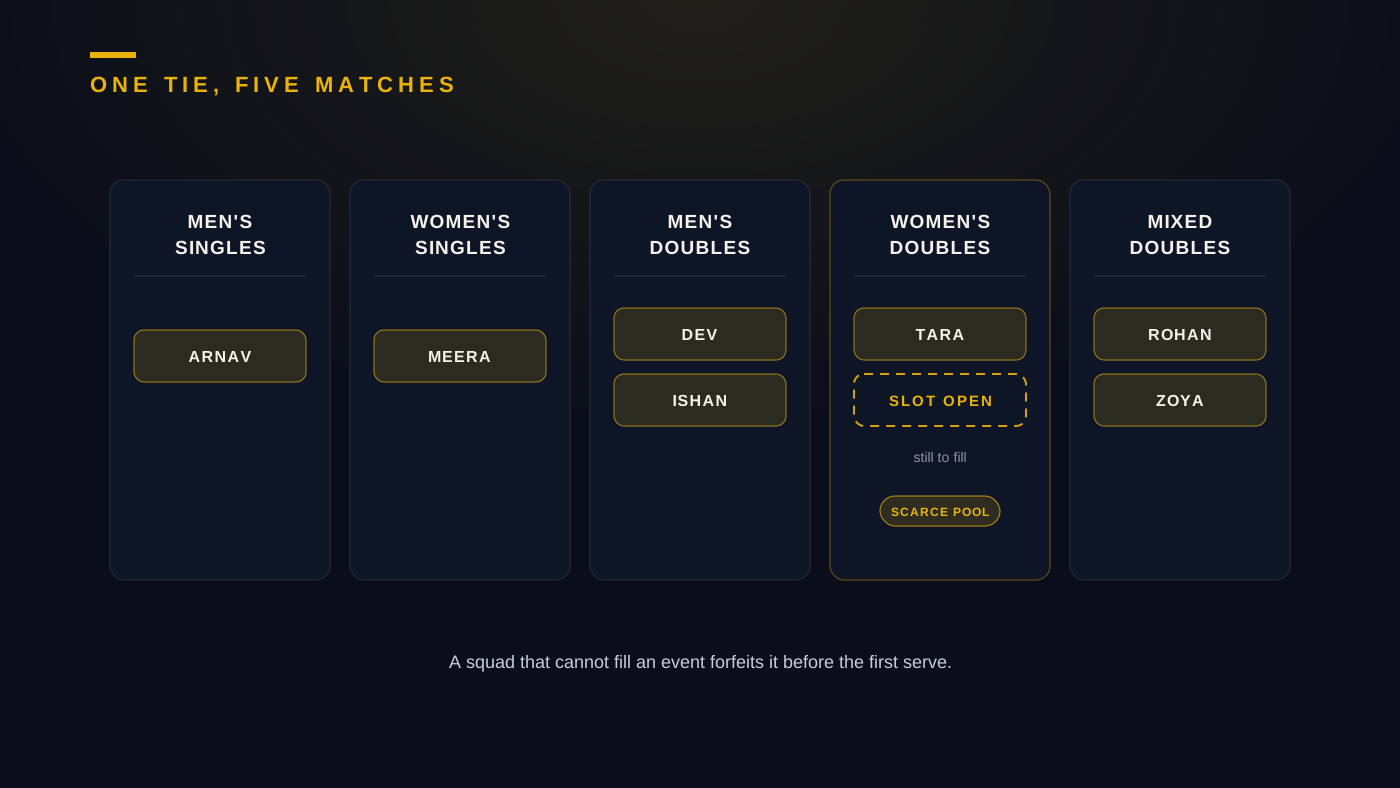
A typical league tie is a set of matches played across events. A common five-match format looks like this: men's singles, women's singles, men's doubles, women's doubles and mixed doubles. Leagues vary, some play seven matches with a second singles or doubles, but the structure is always the same. To win a tie, you must field a competitive pairing or player in every event.
This changes squad building completely. A cricket captain can buy the eleven best players available and sort out the batting order later. A badminton captain who buys the six best players in the pool might discover they are all singles specialists and he cannot field a doubles pair worth anything. Doubles is a different sport at the net: different reflexes, different positioning, different chemistry. And if the pool is short on women players, the mixed and women's events become unfillable at any price.
So before your auction, publish the tie format and make every captain write down the slots they need to fill. The auction is then a slot-filling exercise under budget pressure, which is exactly what makes it fascinating to watch.
Categorise players by event, not just by skill
Your registration form should capture, for every player:
- Preferred events. Singles, doubles, mixed or combinations. Most club players have a clear preference and captains need it on screen during bidding.
- Doubles style. Front-court finisher or back-court hitter. Two back-court players make a poor pair, and experienced captains bid on complements, not just quality.
- Level markers your league trusts. Club grading, tournament history or simply an honest self-rating. Avoid inventing precise rankings nobody can verify.
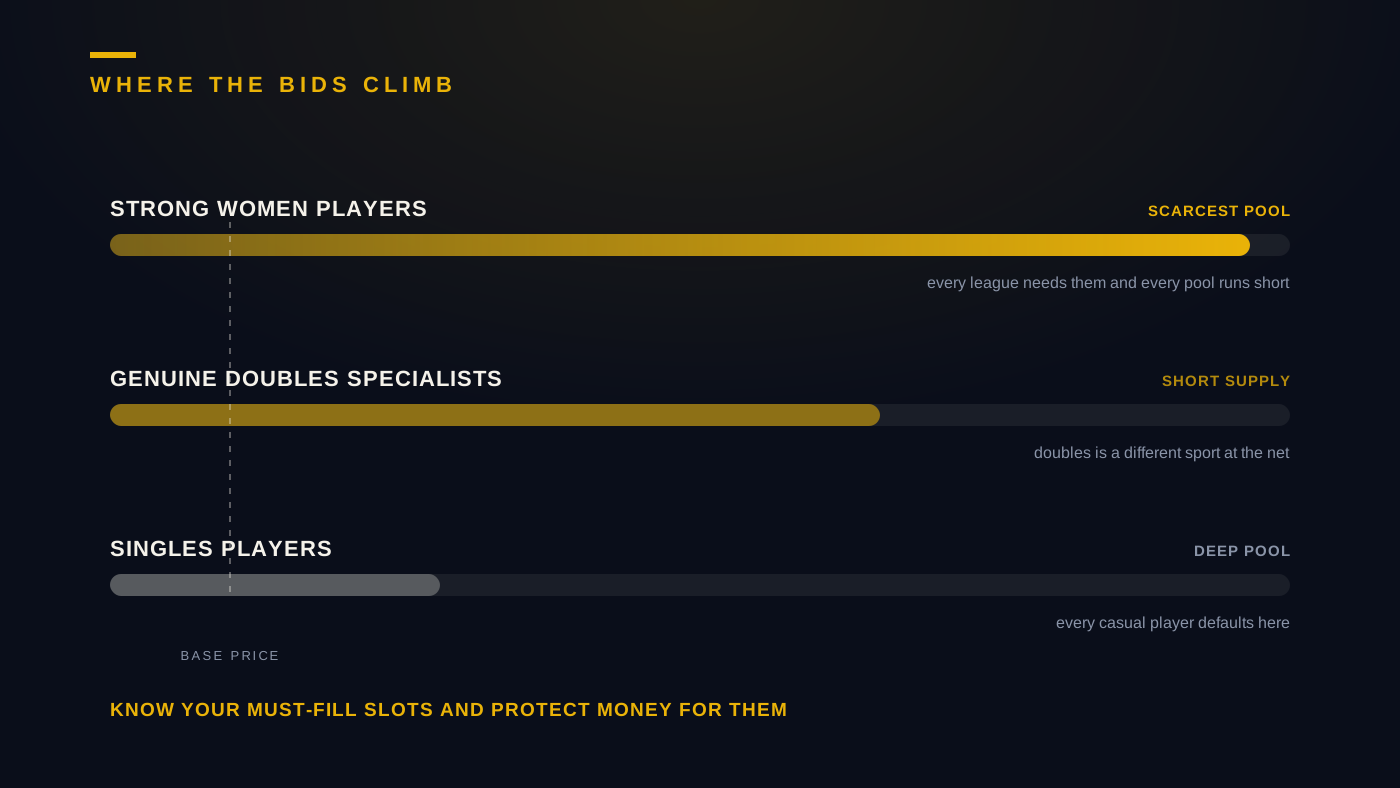
Then build your auction categories around scarcity. In most local pools the order of scarcity is roughly: strong women players first, genuine doubles specialists second, singles players last, because every casual player defaults to singles. Auction the scarce categories with care, and expect the room's biggest bids there.
A note on tooling: cricket-first auction software will show your players with strike rates and bowling styles, which is nonsense in a badminton hall. Purpose-built platforms handle this properly. AuctionXI lets you rename every player field for your sport, so the big screen shows preferred event, doubles side and club level, and your whole pool imports from one Excel sheet with photos mapped automatically.
Two auction formats that work for badminton
Format one: open pool. Auction every player in one pool and let captains build squads as they see fit. Simple to run, and the slot pressure creates drama on its own: watch the room when the last strong women's doubles player comes up and three teams still have an empty slot.
Format two: slot-wise pools. Auction in blocks by category: women's singles pool, men's doubles pool and so on, with captains required to fill each slot from its pool. This guarantees every team can field every event, which matters in leagues where the player pool is thin. It needs more preparation, and players who play multiple events should be placed in their scarcest category.
For a first-season league, open pool with a published tie format is usually the right call. Add slot rules in season two once you know your pool.
Either way, set squad sizes with the format in mind. A five-match tie needs a minimum of around six to eight players once you account for the usual rule that no player plays more than two matches per tie. Eight to ten is a comfortable squad, with cover for the office league reality that somebody is always travelling on match night.
Purse advice for a slot-driven market
Badminton purses need one adjustment from the standard formula: budget for scarcity spikes. In a pool where women players or doubles specialists are rare, their prices will run far above the average, and a captain who spent evenly early on can be locked out of an entire event. Brief your captains: know your must-fill slots and protect money for them.
A purse of around eighty times base price for a squad of nine is a sensible starting point, with a squad minimum so nobody hoards and increment steps that climb at the top end to keep bidding wars quick.
One more badminton-specific rule worth adopting: decide in advance what happens if a team ends the auction unable to fill an event slot. The clean answer is a final assignment round where unsold players go to short-handed teams at base price. Unsold players and re-auction rounds are standard in good auction tools, so this costs you nothing but a written rule.
Running the night: corporate league edition
Most badminton league auctions in India happen in an office meeting room or a club hall on a weekday evening, often with the company leadership watching. A few things make the night land:
- Make it look like an event. A projector screen with the current player, live bids and every team's remaining purse turns a conference room into an auction hall. If half the company is remote, share a viewer link that anyone can open on a phone, with no cap on how many people watch.
- Give the host a script. A line per player, a little theatre on the big bids and a brisk pace of about a player per minute. Our auction anchor script and hosting guide has a ready structure.
- Let sponsors in. Corporate leagues usually have an internal sponsor or a vendor partner. Full-screen sponsor scenes and a scrolling sponsor strip between lots are easy goodwill.
- Close the loop the same night. Export the final squads and prices to a workbook and post it in the league group before everyone leaves. In an office, transparency is everything.
If your league spans multiple offices or cities, the auction can run as a hybrid event with remote captains bidding through the operator. Our guide to remote and hybrid player auctions covers the setup, and our office and society auction guide covers the organisational side for corporate formats.
Common badminton auction mistakes
- Auctioning without publishing the tie format. Captains cannot value players if they do not know the slots.
- Ignoring doubles chemistry. Encourage captains to think in pairs. Some leagues even allow declared pairs to be auctioned as a single lot, which is a lovely twist if your pool supports it.
- Underpricing scarce categories. If strong women players start at the same base price as everyone else, expect chaos when the bids jump tenfold. A higher base price in scarce categories keeps the market orderly.
- Running it on a cricket spreadsheet. Wrong fields, manual purse maths and no way for the hall to follow. A tool where you pay once per tournament and rename the fields to fit badminton removes all three problems.
Badminton auctions reward the organiser who understands the slot puzzle. Publish the format, categorise by event, protect the scarce pools and give the night a big screen. Do that and your league's auction evening will be talked about long after the season's last smash.