Every organiser hits this question sooner or later. The auction date is fixed, the captains are confirmed, and someone in the committee asks: do we actually need to pay for auction software, or will a spreadsheet do?

It is a fair question, and the honest answer is: it depends on your auction, not on what any software company tells you. We build paid auction software at AuctionXI, so we have an obvious interest in your answer, but we will make the case for free first and properly, because for a lot of small auctions free is genuinely the right call.
The free options, honestly assessed
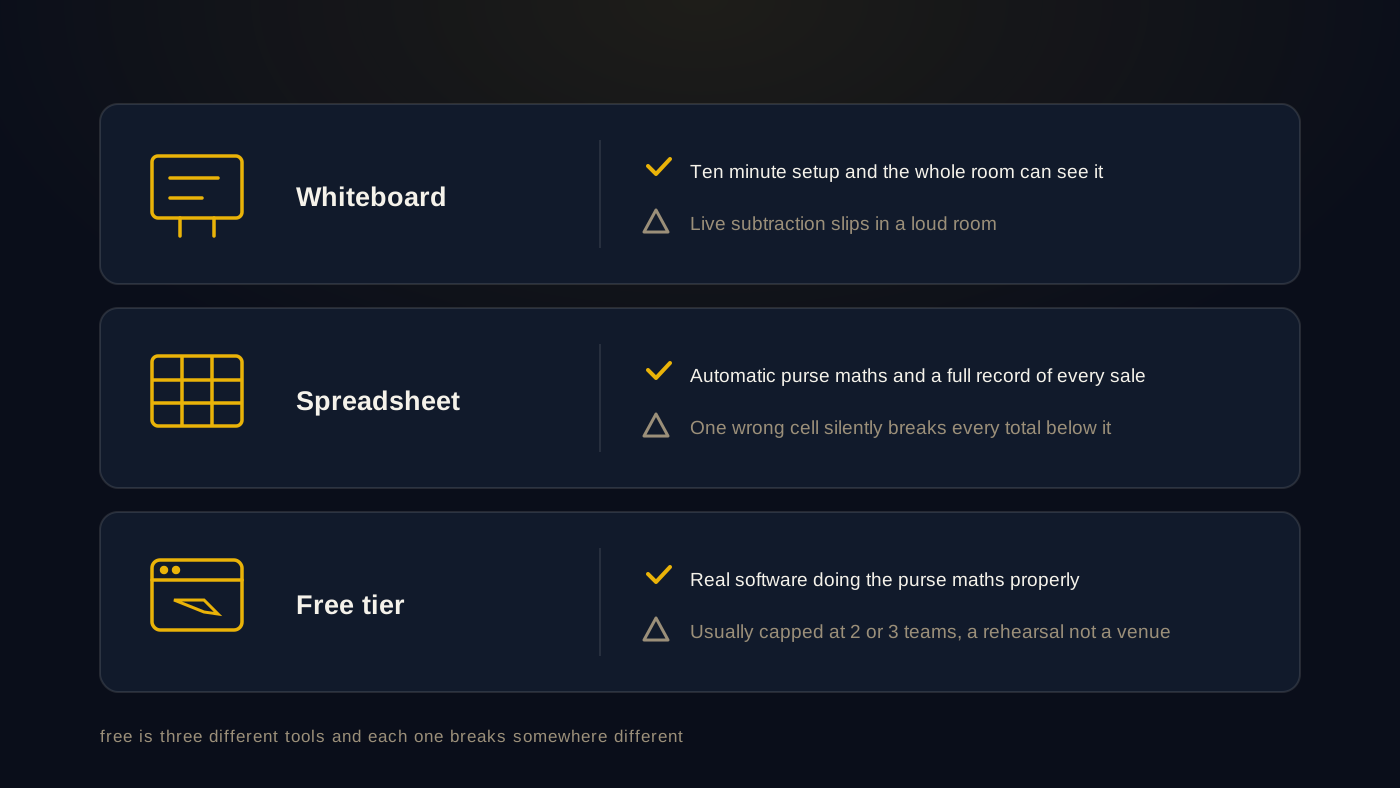
Free is not one thing. There are three quite different ways to run an auction without paying, and they fail in different places.
Pen, paper and a whiteboard
The original method, and do not dismiss it. A whiteboard with team names, a marker, a printed player list and a confident auctioneer can carry a small auction on pure energy. Everyone can see the board, there is nothing to crash and setup takes ten minutes.
The weakness is arithmetic. Every sold player means a subtraction done live, in a noisy room, on a purse that someone wrote down three columns ago. One slip and a team spends money it does not have, and you usually only discover it near the end, when unwinding it means reopening sales that other captains planned around. The whiteboard also keeps no history: if two people remember a price differently, there is no record to settle it.
Spreadsheets
The most common free setup, and a genuine step up. A well-built sheet subtracts purses automatically, keeps a full record of every sale and can be projected onto a screen. If your committee has one person who is properly comfortable in Excel, a 4-team, 40-player auction is entirely manageable this way. We have published a free cricket auction Excel template precisely because this path works for many leagues.
The weaknesses are speed and fragility. Bids come faster than typing, so the sheet lags the room and the auctioneer ends up repeating numbers. One wrong cell reference or an accidental sort breaks every total below it, silently. And a spreadsheet has exactly one operator: if that person needs a break, the auction stops. None of this is fatal for a small, patient room. All of it compounds as the room gets bigger and louder.
Free tiers of paid tools
Nearly every paid auction product now offers a free tier, and these fix the arithmetic problem properly: real software does the purse maths, keeps the history and shows a live screen. The catch is the team limit. Most free tiers in this category cover 2 or 3 teams, which is enough to test-drive the product thoroughly but rarely enough to run a real tournament. Treat free tiers as what they are: a genuinely useful rehearsal space and a way to compare products before paying, not a permanent home for a 10-team league.
For transparency: AuctionXI itself does not have a free tier. We charge once per tournament, with plans starting at ₹3,999 for up to 6 teams as of July 2026, and we offer a live demo you can explore without signing up. Other products in the market structure their free offerings differently, so check each product's own pricing page for current details.
When free genuinely suffices
Be suspicious of anyone selling software who cannot describe the auctions that do not need it. Here is that list, plainly.
- A small society or friends auction. Four to six teams, thirty to fifty players, everyone in one room, nobody streaming anything. A spreadsheet and a projector cover this.
- A trusted, competent operator. The single biggest risk in a manual auction is purse arithmetic. If one committee member is genuinely good with a spreadsheet, has built the sheet beforehand and has rehearsed it once, that risk drops a long way.
- Low stakes and high goodwill. If a maths mistake would be laughed off and fixed over chai, you do not need software-grade correctness. Not every auction is a courtroom.
- A one-off event on a tight budget. If the tournament budget is a few thousand rupees in total, spending a third of it on software is poor planning. Put the money into the ground booking and run the auction manually.
If this is you, save the money. Read our guide on how to run a cricket player auction, build the sheet, rehearse once and you will have a good night.
When paid earns its fee
Paid software stops being a luxury at fairly predictable thresholds. Watch for these.
The room gets big
Once you have a hall full of players and family rather than a table of captains, presentation becomes the product. People came to watch their own sale. A spreadsheet on a projector technically shows the numbers; purpose-built software shows a proper big-screen production, with player photos, live purses and sold moments that feel like an event. This is the difference between a meeting and an auction night.
The audience is not all in the room
The moment even a handful of players are following from another city, free options run out of road. A spreadsheet cannot give a remote viewer a live view, and WhatsApp-ing screenshots every five minutes gets old fast. Paid tools solve this with viewer links and streaming overlays. AuctionXI, for instance, gives every auction a viewer link that opens in any phone browser with no cap on viewer numbers, plus a transparent overlay for YouTube streaming. If broadcasting is on your list, our guide to putting your auction on a projector and YouTube walks through the full setup.
The team count climbs
Eight, twelve, twenty teams means eight, twelve, twenty purses updating live, squad limits being enforced and captains asking "how much do I have left?" every other minute. Manual methods degrade quickly here because every extra team multiplies the arithmetic. Software does not care: twenty purses are as easy as four, and each captain can check a live balance instead of asking the operator.
Mistakes become expensive
Some auctions carry real money: entry fees per team, sponsors who paid for visibility, a franchise-style league with points that matter for months. At that point "we will fix it over chai" no longer applies. You want purse maths that is tracked exactly and can never go negative, an undo for the auctioneer's inevitable slip, a proper unsold re-auction round and a full export afterwards so every captain gets the same record of who spent what. These are exactly the features paid tools charge for, because they are the ones that prevent the expensive argument.
Sponsors expect screen time
If local businesses have put money into your tournament, auction night is your best chance to deliver visibility, and a hall full of people staring at a screen for two hours is prime inventory. Sponsor scenes and logo strips on the auction display are a paid-software feature that can quite literally pay for the software: one modest sponsorship usually covers the fee several times over.
A simple way to decide
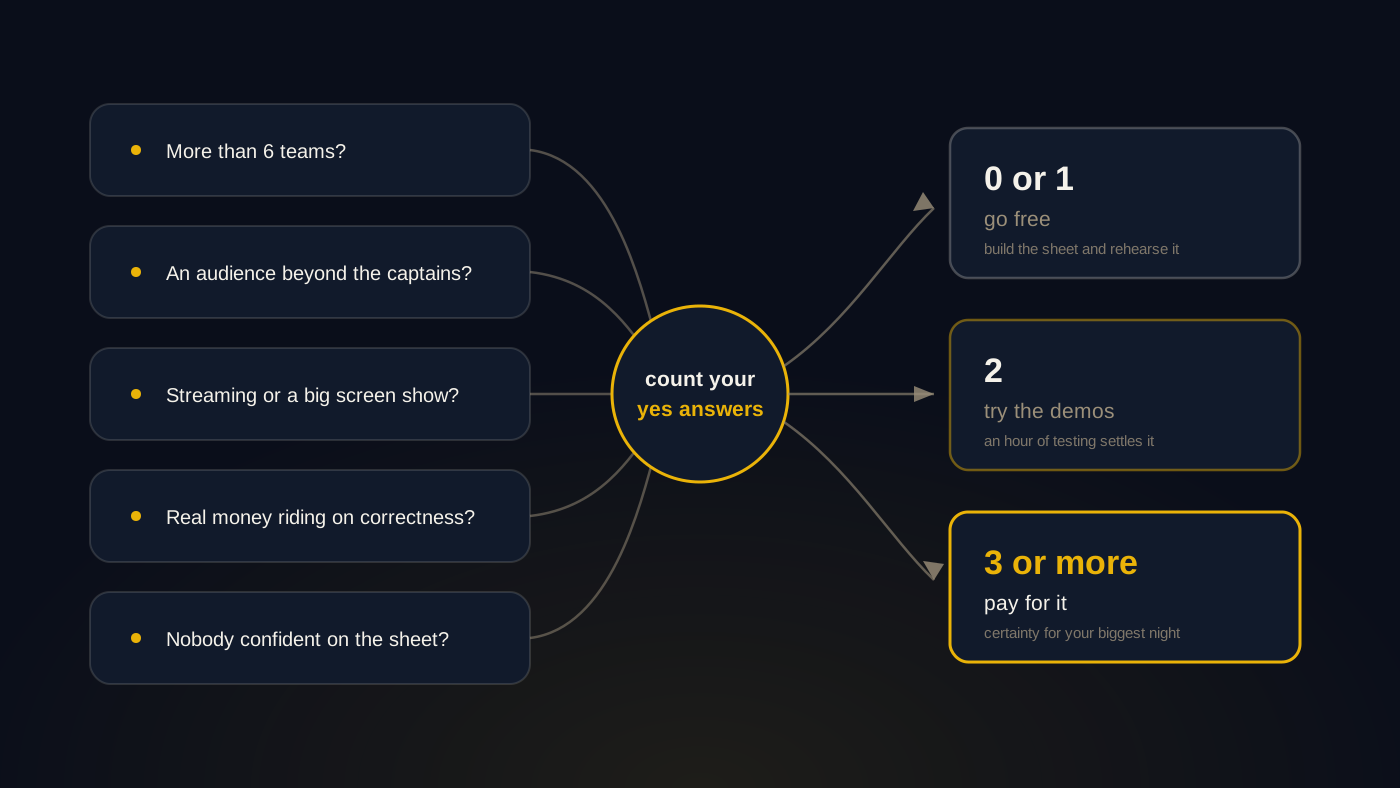
Answer these five questions honestly.
- More than 6 teams?
- An audience beyond the captains, in the room or remote?
- Streaming or a big-screen production planned?
- Real money riding on correctness: fees, sponsors, a season-long league?
- Nobody on the committee who is genuinely confident running a live spreadsheet?
Zero or one yes: go free. Build the sheet, rehearse it and spend the money on the tournament itself. Two yeses: try the free tiers and demos of paid tools, because you are near the line and an hour of testing will settle it. Three or more: pay. The fee is small against the tournament budget, and what you are buying is not features, it is the certainty that the most-watched two hours of your season will not be remembered for a maths error.
One last honest note. The best free setup, run by a prepared operator for the right-sized auction, beats a paid tool used carelessly. Software removes the arithmetic risk and gives you the production, but preparation is still what makes auction night good. Free or paid, do the rehearsal.